System One AI: don't burn 800ms just to get one routing keyword
Explore System One AI with TypeSafe Jev: replace slow LLMs with Typed Decisions, probability distributions and the three primitives Choice, Score and Noul.
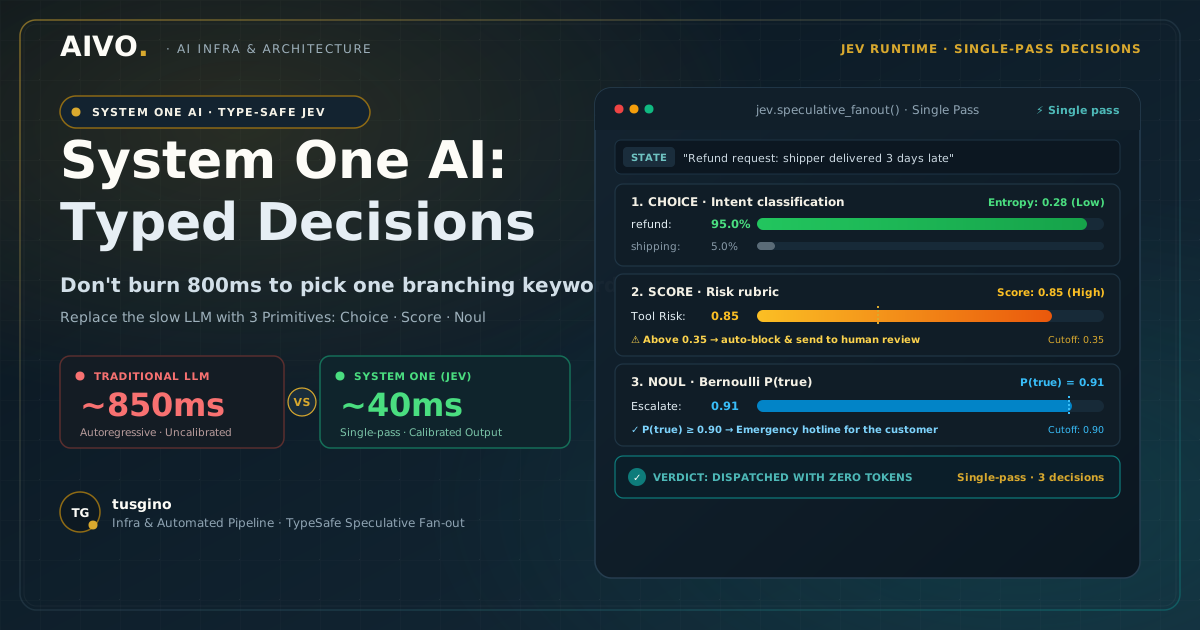
if-else statement. A System One model returns Typed Decisions with a calibrated probability distribution, and does not generate a single text token.The 800ms paradox of the software engineer
Look at a familiar piece of customer-message routing code in today’s agent systems:
// The naive way we still use every dayconst response = await openai.chat.completions.create({ model: "gpt-4o", response_format: { type: "json_object" }, messages: [ { role: "system", content: "Classify this message into 1 of 2 groups: 'refund' or 'shipping'." }, { role: "user", content: customerMessage } ]});const route = JSON.parse(response.choices[0].message.content).intent;From the point of view of an infrastructure and automation engineer, the code above is a complete waste:
- Terrible latency: You spend 800ms to 1.5 seconds only to get back a string of 6 characters (
"refund"). - Unreasonable token cost: You force a GPU to run autoregressive decoding and generate dozens of JSON tokens with heavy syntax.
- Schema Fragility: Even with Structured Outputs, a text-generating model still has some chance of producing a strange string or a timeout.
- Uncalibrated Guess: The JSON string tells you the model chose
"refund", but it does not tell you whether the model is 99% sure or just flipping a coin at 51% vs 49%.
That is why we need a shift in thinking: the System One Model.
Core concept: what is a System One Model?
A System One Model is an AI model that does not generate text. It runs a single inference pass and then returns a decision that already has a data type (Typed Decision) with a calibrated probability distribution, instead of decoding token by token like an LLM.
The name comes from psychology. The economist Daniel Kahneman once split human thinking into two mechanisms in Thinking, Fast and Slow:
- System Two: Slow, step-by-step logical reasoning, uses a lot of energy (similar to reasoning models and LLMs that generate long text).
- System One: Lightning fast, intuitive reflex, recognises patterns in an instant based on accumulated probability.
View diagram data
type: flowchart
title: System One model processing flow
desc: Five steps from Input Request through Vector Logits to Gating and safe execution
nodes:
  - id: input
    label: Input Request
    sub: User prompt / Chat / API
    kind: input
  - id: sys1
    label: System One Engine
    sub: Single Pass Vector Logits
    focal: true
  - id: typed
    label: Typed Decision
    sub: Choice, Score or Noul
    focal: true
  - id: gate
    label: Threshold Gating
    sub: Check Confidence & Risk
    kind: security
  - id: exec
    label: Safe Automation
    sub: Run automatically or hand off to a human
edges:
  - [input, sys1]
  - [sys1, typed]
  - [typed, gate]
  - [gate, exec]
In September 2026, TypeSafe AI (founded by Diogo Almeida — a former OpenAI researcher and co-author of the RLHF technique) announced Jev, the first model built only for System One (see the official primitive documentation). The list price is $42/Btok, equal to $0.042 per million input tokens, and output tokens are free — Jev 1.13 even ships with open weights.
The System One philosophy is firm: AI does not generate text (No Text Generation). AI only makes decisions that have a data type (Typed Decisions) with a calibrated probability distribution (Calibrated Distribution).
- Generates tokens one by one (800ms - 2000ms).
- Returns text/JSON: to get the decision, your code must parse it and trust the format.
- Bills both input and output tokens — the generated JSON is billed too.
- Easily “guesses” when the question is vague.
- Infers directly through an embedding and a classification head.
- Returns a static data type plus a probability distribution for each option.
- Bills input tokens only; output tokens are free.
- Lets you measure uncertainty (Entropy) so you can stop safely.
The three core primitives of a Typed Decision
These three primitives are the whole grammar of System One: Choice picks a label, Score measures a level, Noul answers Yes/No with a probability.
View diagram data
type: layers
title: Speculative Fan-out architecture
desc: Four layers processed in parallel in a single inference pass of the System One model
nodes:
  - id: state
    label: 1. Input State (context)
    sub: Customer complaint / Chat log / Shell command
    kind: input
  - id: jev
    label: 2. Jev Engine (Single-pass)
    sub: One single matrix inference pass
    focal: true
  - id: fanout
    label: 3. Parallel Typed Decisions
    sub: Choice (intent) · Score (level) · Noul (phone call)
    focal: true
  - id: pipeline
    label: 4. Gating & Decision Pipeline
    sub: Safe automation or hand off to a human
    kind: security
edges:
  - [state, jev]
  - [jev, fanout]
  - [fanout, pipeline]
1. Choice — Multi-class classification and distribution shape
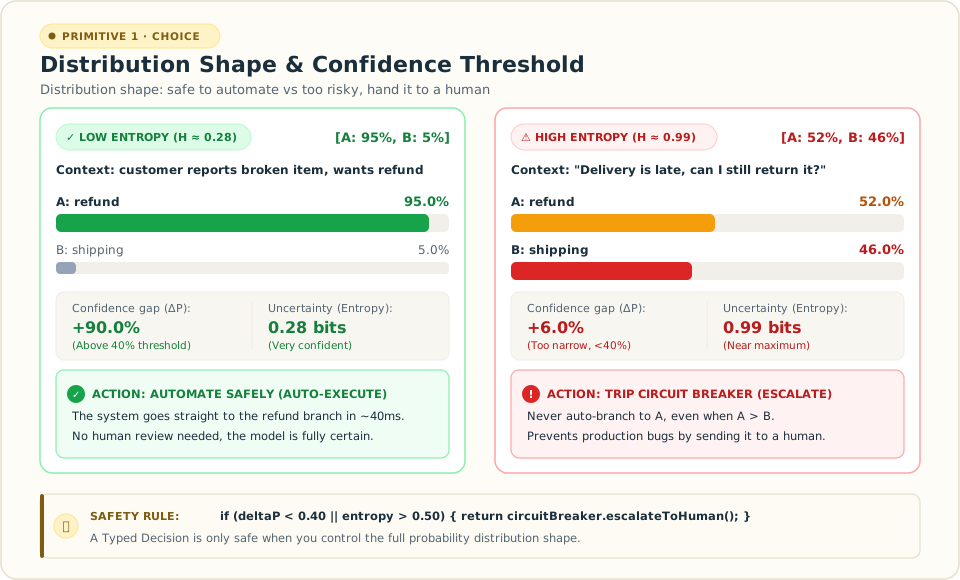
Choice picks 1 label from a fixed list (up to 255 labels). The key point: it does not return only the winning label, it returns the whole shape of the probability distribution (Distribution Shape).
If the result is [A: 95%, B: 5%], the model is extremely sure. But if the result is [A: 52%, B: 46%], even though , choosing automatically is a production bug waiting to happen — the chaos (Entropy) is too high to trust.
2. Score — Ordinal scale
Instead of discrete classification, Score rates a level on a quantitative scale (usually from 0.0 to 1.0, or a rubric from 1 to 5 stars). The returned value is the probability-weighted average of the whole scale:
- Measure the severity of an incident (Severity:
0.92). - Score how harmful or risky a tool command is (Risk Score:
0.85).
3. Noul — Bernoulli probability from 0 to 1
Noul (a playful shortening of Bernoulli) answers Yes/No questions. Noul is not a rough true/false boolean type. Noul returns a real number:
Why not let the AI return a boolean? Because the decision threshold (Confidence Threshold) is the right of the system engineer, not of the model!
- For a task that sends a suggestion email: is enough to allow the send.
- For a task that deducts money from a wallet: you must require .
The practice area: hands-on labs
Below are 3 real scenarios that simulate how to fit a System One Model into a modern software architecture:
Choice("intent", …) sends both the label and the description to the model, so the description is where you teach it to tell two near-identical labels apart. Delete the description and the model has to guess.
No distribution yet. Press EVALUATE_DECISION to call TypeSafe.
A confidence threshold only means something once a real probability distribution exists. Call TypeSafe first, then drag the threshold to watch the Circuit Breaker flip.
The chips are three sample commands — you can still edit after picking one. The chip label is a human judgement while the risk score on the right comes from the model: compare the two.
Score("risk", criteria=[…]) takes a list of levels ordered low to high; each level is a full sentence, because that is what the model scores against. Collapse it to 2 levels and every command is only "safe" or "dangerous".
git statusRead-only view of the git worktree state. Nothing on the filesystem is changed.
Confidence: —
A risk ceiling can only block something once the model returns a real score. Press EVALUATE_TOOL_RISK to score this command.
Three questions run in one single HTTP call: Score for the level, Choice for routing, Noul for the yes/no question. Edit here and the model scores against exactly what you just defined.
…One single HTTP call, three questions running in parallel over the same context. No text is generated for you to parse.
Two architecture patterns you must remember
From the 3 hands-on labs above, two architecture lessons shape the whole way we build the next generation of agents:
1. Tool Risk Gating (a safety gate for AI agents)
When you give an agent the right to run dangerous commands (Shell script, Database mutation, API that calls outside), relying on a “be careful” prompt is meaningless.
Instead, before every tool run, we use the Score primitive to measure a Risk Score. If the command passes the safe threshold (), the system automatically blocks it (Intercept) and asks for an approval signature from a human (Human-in-the-loop).
const risk = await jev.score(toolCall.command, {  rubric: "0.0: Read-only safe -> 1.0: Irreversible destruction"});
if (risk > 0.35) {  await requestHumanApproval({ command: toolCall.command, riskScore: risk });  return;}
await sandbox.execute(toolCall.command);
2. Speculative Fan-out (grouping reasoning branches)
Instead of making 3 API calls to the LLM one after another:
- Ask about customer sentiment? (800ms)
- Ask the main intent? (800ms)
- Is an urgent phone call needed? (800ms)
System One lets you group all 3 questions into one single API call (POST /v1/systemone). Jev loads state once, then evaluates every question in parallel on that same context, so all 3 decisions always stay consistent with each other — something that 3 sequential calls cannot guarantee.
Steps to deploy in your own project
- Find the routing bottlenecksCheck the flows in your codebase that use an LLM only to get a boolean or an enum back.
- Design the primitive schemasReplace long-winded prompts with standard
Choice,ScoreandNouldefinitions. - Set the Confidence ThresholdSet the confidence threshold and the Circuit Breaker mechanism that hands the case back to a human when the model is unsure.
- Measure real latencyMeasure P95 latency and token cost on your own data. Do not trust a generic benchmark number: long context and complex questions both change the latency.
A decision that has a data type is the decision with the fewest surprises. Never let AI guess when you cannot control the probability distribution.
— tusgino
- Stop forcing an LLM to generate JSON text only to serve
if-elsebranching logic. - A System One Model (Jev) returns Typed Decisions with a probability distribution, generates no text and does not bill output tokens.
- The set of 3 primitives Choice, Score and Noul lets you control risk thanks to a calibrated probability distribution.
- Always set a Confidence Threshold to trigger the Circuit Breaker when uncertainty (Entropy) passes the safe limit.
Frequently asked questions
How is a System One model different from a traditional LLM?
Why is Noul not an ordinary Boolean type?
How does Speculative Fan-out work?
When should you still use an LLM instead of a System One model?

Related articles
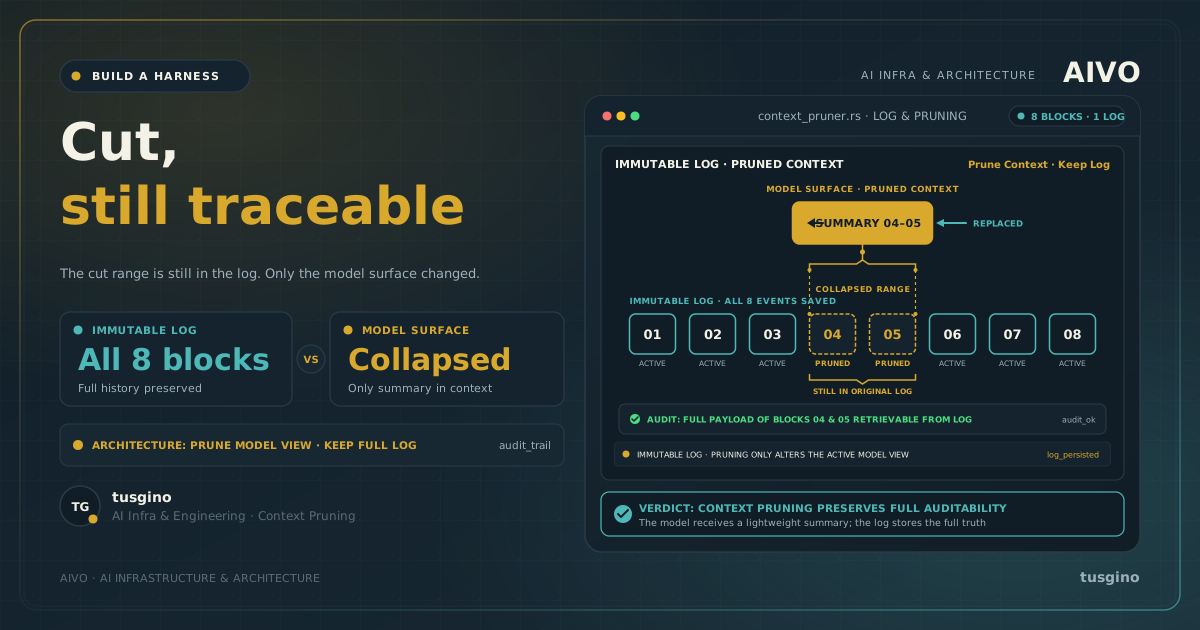
Cut the context, keep the audit trail
Compaction deletes nothing. It only shadows a range on the surface sent to the model, records exactly which range, and leaves the original in the log for later.
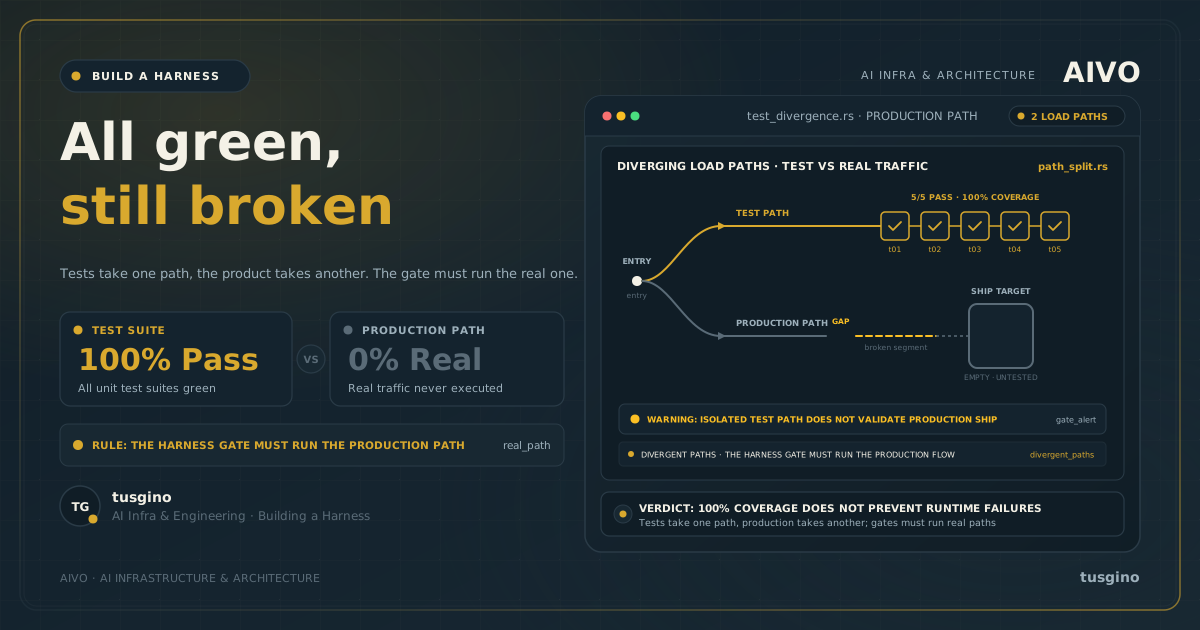
100% coverage, and it still did not run
A feature was completely dead in production while 178 tests were green and coverage held at 100%. Tests measure lines that ran, not the path that ships.
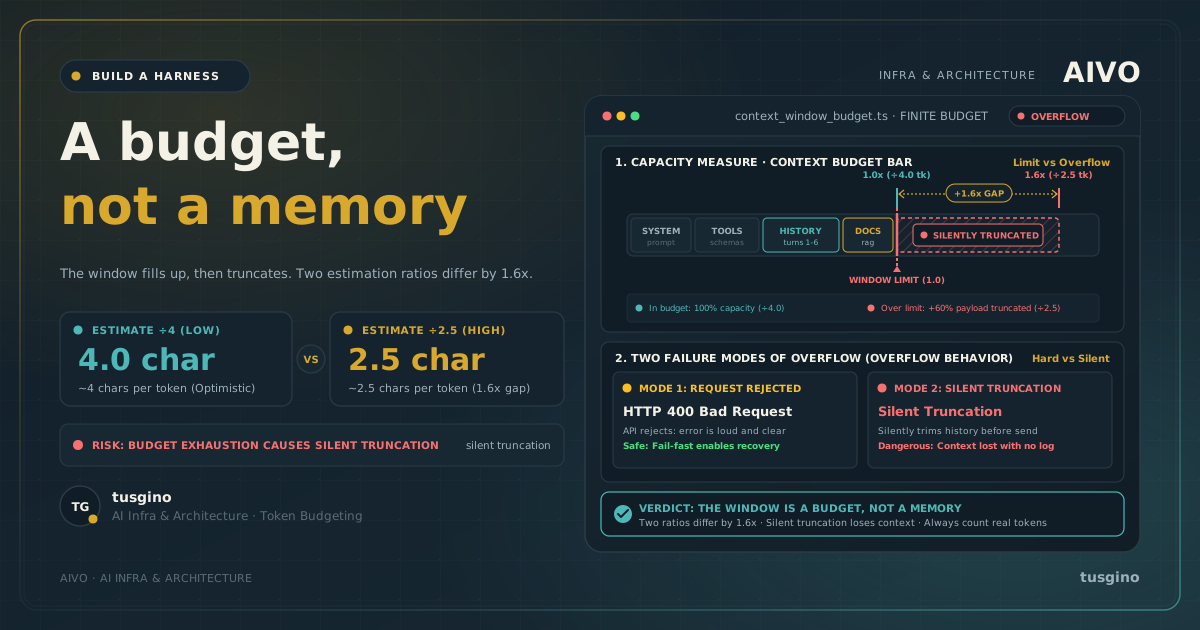
The context window is not memory
A context window is a finite budget, not a memory. On the same request, two published token ratios differ by 1.6x, and you cannot tell which one you are on.